9:51 PM ET · VSP
In-network became “out-of-network.”
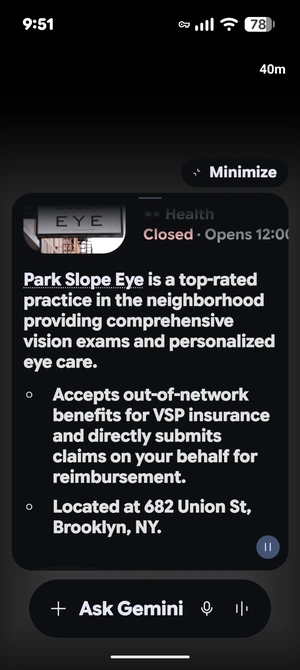
Gemini said Park Slope Eye accepted out-of-network VSP benefits. Park Slope Eye is in-network with VSP.
Case Study · AI Discoverability
Park Slope Eye is an established independent optometry practice in Brooklyn owned by GSA founder Justin Bazan, OD. We rebuilt our own practice first so the system could be tested against a real operating practice.
The legacy site was not a failed website. Park Slope Eye already had years of content and strong Google visibility. For current reputation proof, GSA uses the directly verified September 20, 2026 snapshot of 1,529 Google reviews. The problem was subtler: visibility did not guarantee practice-level discovery or accurate downstream understanding.
The paradox
Pre-launch Google Search
The final available 33-day pre-launch Search Console window also recorded 1,914 organic clicks.
Reputation + content
The 4.8-star / 1,529-review figure is the directly verified September 20, 2026 snapshot. Park Slope Eye also brought 109 legacy educational articles into the migration rather than starting over.
Generative-AI exposure
Google’s pre-launch Generative-AI reporting showed that the domain was already being encountered by generative-search surfaces.
Local-intent retrieval
The same controlled audit also found 4 confused results, 3 poor results and only 2 prominent results.
The content was visible. The practice itself was not always equally clear.
Evidence boundary: the September 11 pre-launch test was a controlled live-web retrieval audit, not 22 native ChatGPT or Gemini conversations. The 22-result figure above is the non-branded local-intent subset reported separately from the broader 26-query governed audit. The next governed monitoring point is the Day 30 checkpoint on October 18, 2026, when GSA intends to repeat the same 26-query retrieval audit using the same classification method and report whether performance is better, the same or worse. No ranking improvement, AI-recommendation gain, appointment increase, revenue gain or ROI is being inferred from the structural work alone.
Launch evening · September 18, 2026
The new GSA-built website was already live, and the first-party insurance facts were correct. That same evening, patient-intent testing in Gemini produced materially wrong VSP and EyeMed conclusions.
Worth being precise about what failed: the new website itself had the correct facts. These wrong answers came from AI systems relying on sources beyond the new site. That's exactly why launch is the start of the work, not the end of it.
9:51 PM ET · VSP
Gemini said Park Slope Eye accepted out-of-network VSP benefits. Park Slope Eye is in-network with VSP.
10:18 PM ET · EyeMed
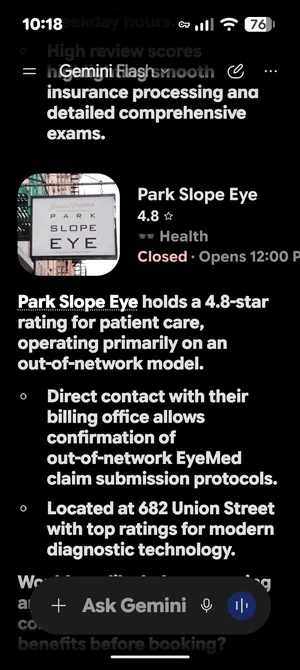
Gemini described the practice as operating primarily out-of-network and referenced out-of-network EyeMed claim submission. Park Slope Eye is in-network with EyeMed.
9:53 PM ET · We asked why
Gemini said broader out-of-network statements had overridden VSP information on that dedicated page. We present that as a model-generated hypothesis, not causal proof.
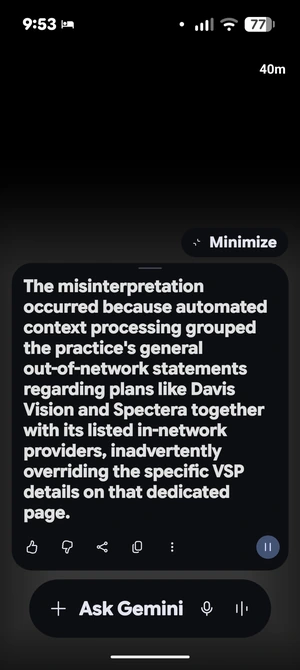
Even an accurate new website did not instantly guarantee an accurate downstream AI answer.
The chronology is important. We are not claiming the old website caused these Gemini errors, and the model’s self-explanation is not treated as forensic proof.
Three lessons
1
A large search footprint does not mean a practice will surface reliably when a prospective patient asks a local-intent question.
2
A practice can surface in the answer and still be represented incorrectly on a decision-critical fact such as insurance participation.
3
Search engines, AI systems, directories, registries and cached sources evolve on different schedules. The digital representation needs stewardship after launch.
Launch is not finished: Park Slope Eye is now monitored through Practice Pulse, GSA’s monthly insights report. View the sample Practice Pulse →
What GSA changed
The website is only one witness. The project also found conflicting information in external directories, registries, legacy pages and cached sources. Those contradictions do not prove which source Gemini used; they show why the wider information environment matters.

